
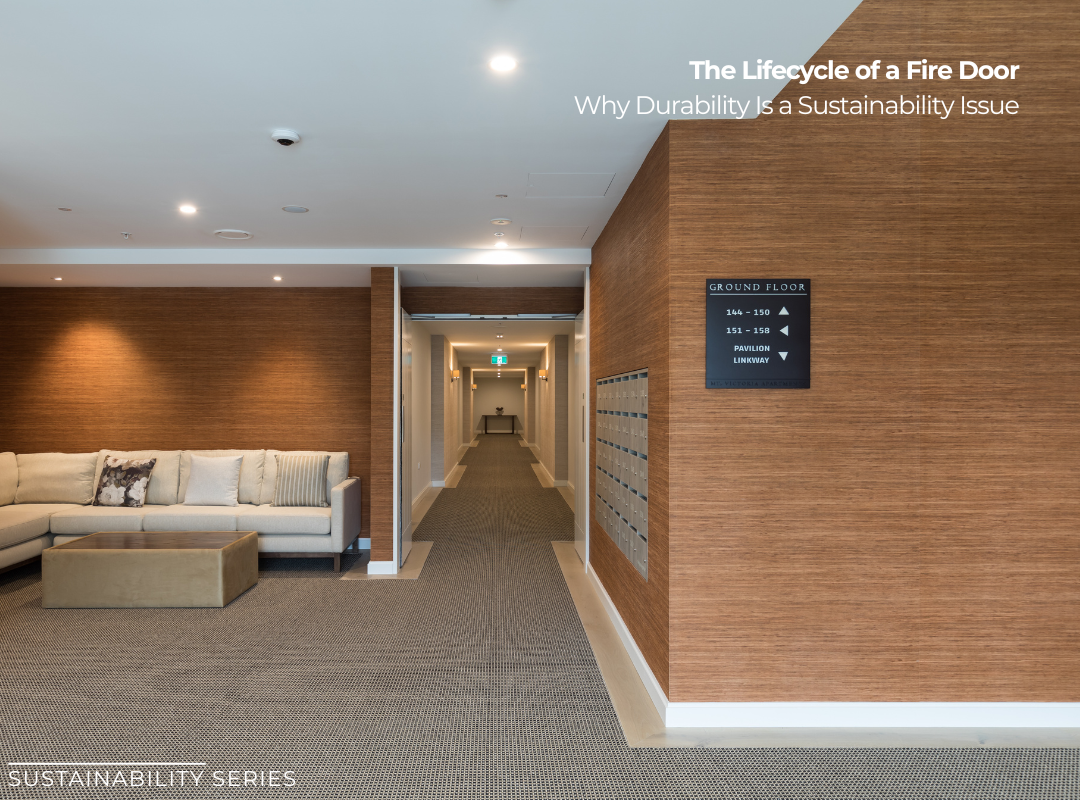
The Lifecycle of a Fire Door: Why Durability Is a Sustainability Issue
A durable fire door is a sustainability asset because it can remain compliant and serviceable for longer, reducing the need for premature repair, remanufacture, replacement, freight and site labour. But durability is not created by the door leaf alone. It depends on the complete doorset being correctly specified, manufactured, handled, installed, used and maintained.
For architects and specifiers, this changes the sustainability question. Instead of asking only what a fire door is made from, ask what will help the complete system perform reliably throughout the building’s life.
What does the lifecycle of a fire door include?
The lifecycle of a fire door begins well before it arrives on site. It includes:
- Design and specification
- Manufacture and documentation
- Transport, storage and site handling
- Installation and certification
- Daily operation and exposure conditions
- Inspection, maintenance and approved repair
- Replacement and end-of-life planning
Decisions made at each stage can extend or shorten service life. A tested doorset that is correctly matched to its wall type and use environment has a sound starting point. The same system can still be compromised by incompatible hardware, moisture exposure, poor storage, incorrect installation, unauthorised alteration or neglected maintenance.
Durability starts at specification
Fire doors perform as complete systems. The leaf, frame, wall interface, seals, glazing and hardware need to work together within the tested or otherwise supported configuration. This makes early coordination one of the most practical durability decisions available to the design team.
Before the doorset is documented, confirm:
- The required fire resistance rating and any smoke or acoustic requirement
- The wall construction and compatible frame detail
- Approved hinges, closers, locks, latches, seals and other hardware
- Vision panel and glazing requirements
- Interior, protected exterior or exposed conditions
- Likely traffic, impact and operational demands
- Finishes, edge sealing and moisture protection
- Inspection access, asset identification and maintenance responsibilities
Resolving these points early reduces the risk of late substitutions, additional machining, unsuitable components or site modifications. Each avoided remake or replacement also avoids another round of material, transport, labour and programme disruption.
The use environment matters
Durability must be considered in context. A low-traffic internal door in a dry environment faces different demands from a doorset serving a busy corridor, plant room, wet area or exposed opening.
Soteria’s Building Product Information Requirements documentation states that Infernoguard fire doors will provide durability of at least 15 years in interior applications that are not subject to moisture exposure. That expectation depends on the doorsets being installed and maintained in accordance with Soteria’s use and care requirements or the applicable contractual guarantees.
| Important distinction: The 15-year interior durability expectation is not the same as the product warranty period. Soteria product data sheets refer to a five-year materials and workmanship warranty, subject to the stated conditions. |
Moisture is a particular lifecycle risk for internal timber fire doors. Soteria guidance notes that moisture can cause swelling, warping, delamination or rot and may compromise fire performance. Wet-area interfaces, humidity, exposure, coatings and the sealing of faces, edges and hardware penetrations therefore need to be considered before the door is ordered.
Manufacture, delivery and site handling are part of performance
A well-resolved specification allows the manufacturer to produce the correct configuration with the necessary evidence and instructions. Local manufacture and technical support can also shorten communication loops when a detail needs clarification.
Durability can be lost between factory and installation if a doorset is delivered into unsuitable conditions, stored incorrectly, damaged by other trades or left unfinished. Soteria’s care guidance calls for doors to be protected from moisture, handled carefully and sealed or finished promptly. Project sequencing should give the doorset a suitable environment, not treat it as a robust site barrier before handover.
Installation determines whether the system begins life correctly
Even a high-quality doorset will not deliver its intended performance if the opening, frame, gaps, fixings, seals, closer or latching arrangement is wrong. Incorrect installation can create immediate non-compliance and may also accelerate wear through misalignment, binding, over-slamming or stressed hardware.
Installers should follow the instructions supplied with the doorset and use the specified fixings, packing, mastics and approved hardware. Certification tags, installer declarations and the fire door register should then provide a clear record of what was installed. This documentation becomes valuable later, when facilities teams need to inspect, maintain or assess an alteration.
Everyday operation is a durability issue
Fire doors in apartments, aged-care facilities, schools and commercial buildings may cycle many times each day. Closers, hinges, latches and seals carry that operational load. If a door begins to drag, slam, fail to latch or sustain impact damage, the issue should be addressed before it damages more of the system.
Good durability is therefore partly a management outcome. Doors should not be wedged open, drilled, trimmed or modified without appropriate approval. New access-control hardware, glazing, signage or services should be checked against the supported doorset configuration before work proceeds.
Maintenance protects service life
Inspection and maintenance keep a fire door functional and help identify small problems before they become replacement problems. Soteria’s care and BPIR guidance includes monthly operational checks and regular checks of seals, hinges, stays, rollers and other hardware. The applicable maintenance schedule and building compliance requirements should always be confirmed for the specific doorset and building.
A practical inspection should look for:
- Damage, swelling, warping or delamination to the leaf or frame
- Loose, worn or stressed hinges and fixings
- A closer that does not close the door smoothly and fully
- A latch that does not engage without undue force
- Damaged, painted-over, displaced or missing seals
- Changes to clearances or evidence of the door dragging
- Unauthorised penetrations, trimming or added hardware
- Missing, damaged or obscured identification tags
Maintenance should preserve the tested system rather than introduce an improvised fix. Where damage or a proposed alteration could affect fire performance, the manufacturer or a suitably qualified passive-fire specialist should be consulted before repair work proceeds.
Repair versus replacement
Replacement should not be automatic, but neither should a damaged life-safety component be retained simply to avoid waste. The right decision depends on the nature of the damage, the available evidence and whether an approved repair can restore the doorset without compromising its rating or operation.
Before deciding, establish:
- The doorset identity, rating and original configuration
- Whether the damage is cosmetic, operational or performance-critical
- Whether the manufacturer supports a documented repair method
- Whether components can be replaced with approved equivalents
- What inspection, certification and record updates are required after the work
Where a compliant repair is supported, it may extend useful life and avoid unnecessary material use. Where the leaf, frame or system has been compromised beyond an approved repair, replacement is the responsible outcome. Sustainability cannot come at the expense of life safety or compliance.
A lifecycle approach for architects and specifiers
Durable fire door specification connects design intent with what happens after practical completion. It gives builders a buildable system, installers clear requirements and building owners useful records for operation and maintenance.
For project teams, the practical approach is straightforward:
- Specify a tested, documented system suited to the wall type and exposure.
- Coordinate hardware, glazing, seals and finishes before procurement.
- Plan delivery, storage and installation conditions.
- Provide clear certification, asset and maintenance information at handover.
- Inspect and maintain the complete doorset throughout its service life.
- Seek approved repair advice before altering or replacing components.
This is where durability and sustainability meet. Extending the compliant, serviceable life of a fire door reduces avoidable replacement and rework while protecting the performance the system was designed to provide.
Build durability into the fire door specification
Soteria Doors helps architects and project teams coordinate New Zealand-made fire door systems with tested configurations, approved hardware information, Masterspec work sections, specification support and project-specific documentation where applicable.
Engage Soteria Doors early to make durability, maintenance and long-term performance part of the specification, not an issue left for the building owner to solve later.
Sustainable Fire Doors NZ: Smarter Specification for Better Building Performance